
Formulation and Delivery - Chemical

Tianyi Xiang, MS
Graduate Research Assistant
University of Minnesota
Minneapolis, Minnesota, United States
Tianyi Xiang, MS
Graduate Research Assistant
University of Minnesota
Minneapolis, Minnesota, United States

Sichen Song, Ph.D. (he/him/his)
Graduate Research Assistant
University of Minnesota
MINNEAPOLIS, Minnesota, United States
Ronald Siegel, Sc.D.
Professor and Director of Graduate Studies
University of Minnesota
MINNEAPOLIS, Minnesota, United States

Changquan Calvin Sun, Ph.D.
Professor and Associate Department Head
University of Minnesota
Minneapolis, Minnesota, United States
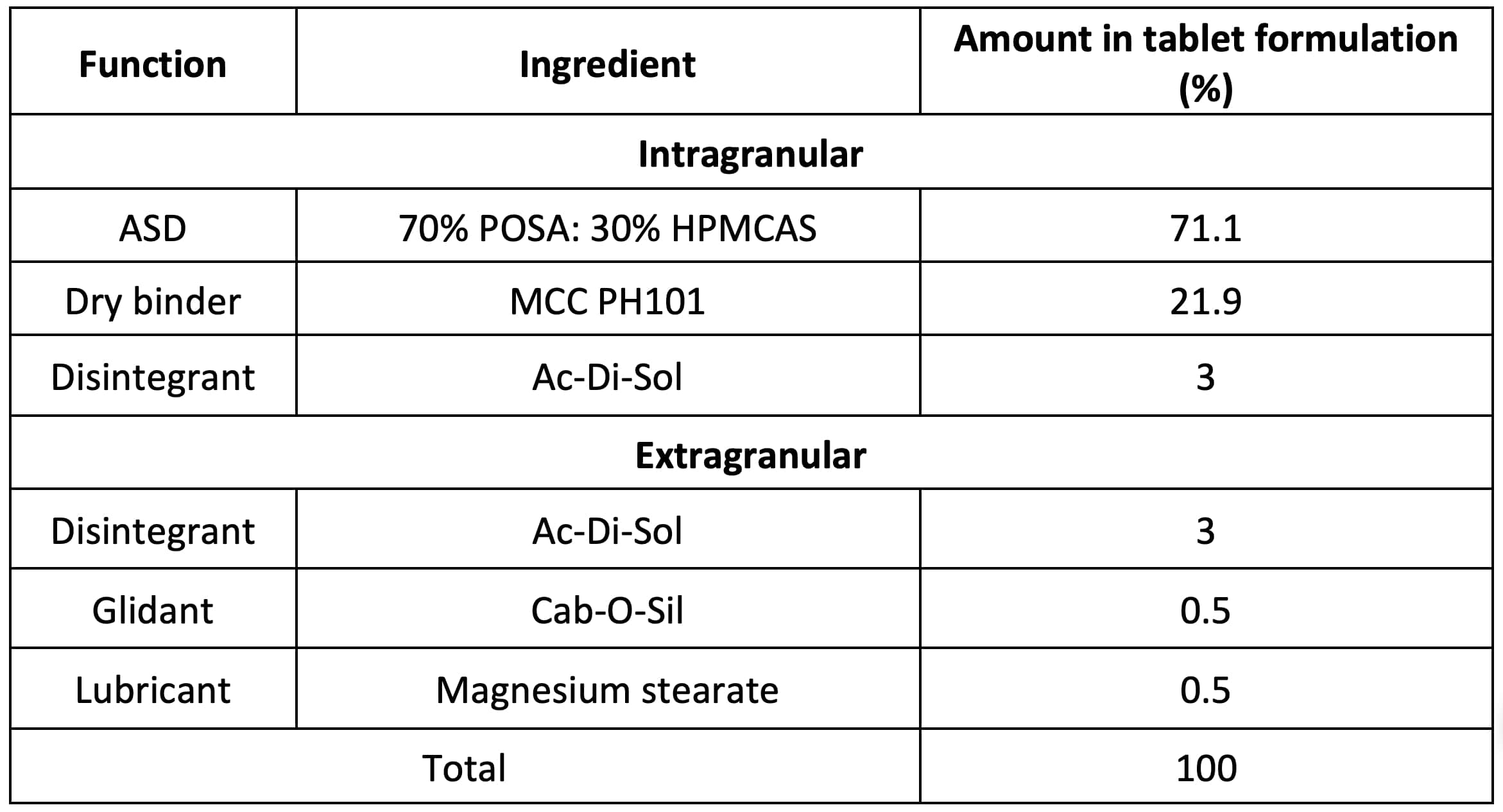 Table 1. Formulation of 50% drug-loading posaconazole tablet containing ASD of 70% posaconazole and 30% HPMCAS.
  Figure 1. a) DSC profiles of pure POSA (black) and its physical mixture with 4% HPMCAS (red), showing melting point depression. b) Viscosity-composition diagram of POSA and HPMCAS at 175 °C. c) Powder dissolution profiles of POSA - HPMCAS ASDs with 60%, 70%, and 80% POS loadings in 0.1 M PBS (pH 6.5) at 37 ˚C. d) Tabletability of powders in different stages of tablet formulation design.
  Figure 2. a) Compressibility profile of the pre-granulation blend. The line was obtained by fitting data with the Kuentz-Leuenberger (KL) equation. b) Flowability of powders in different stages of tablet formulation design assessed by Carr’s compressibility index. c) Friability profile of tablets containing 70% ASD. d) Time-concentration profile of dissolution of final tablets in pH 6.5 PBS with 0.05% v/v Tween 20 at 37 ˚C (non-sink condition, n = 3).