
Discovery and Basic Research
Yongzhe Li, BS
Graduate Student
Purdue University
Lafayette, Indiana, United States
Yongzhe Li, BS
Graduate Student
Purdue University
Lafayette, Indiana, United States
Sung Hyun Joo, n/a
Pharm.D. Student
Purdue University
West Lafayette, Indiana, United States

Yoon Yeo, Ph.D.
Associate Department Head, Industrial and Molecular Pharmaceutics
Purdue University
West Lafayette, Indiana, United States
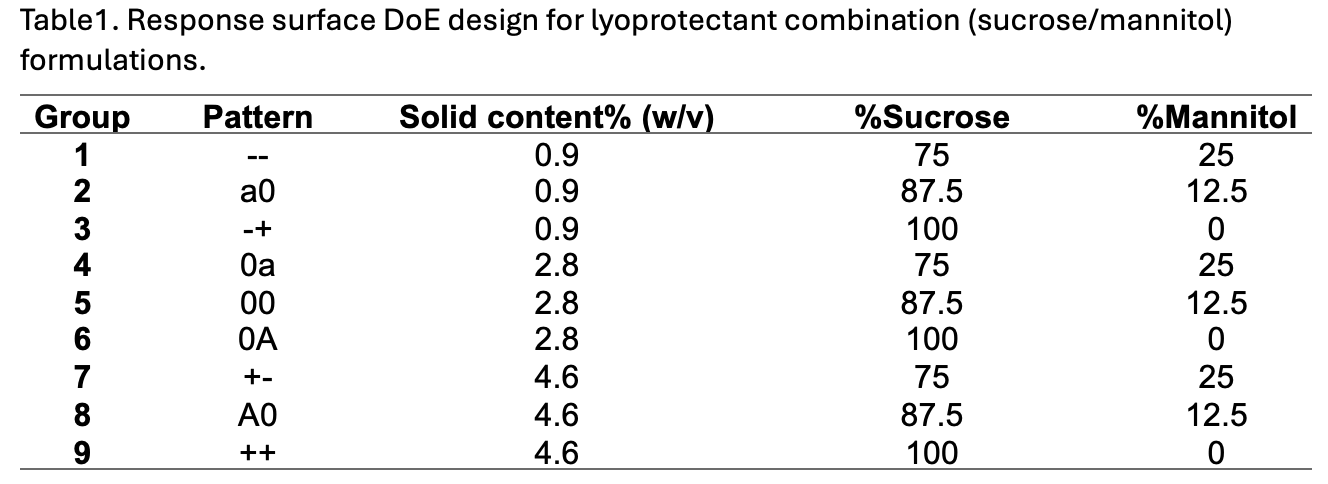 Table1. Response surface DoE design for lyoprotectant combination (sucrose/mannitol) formulations.
 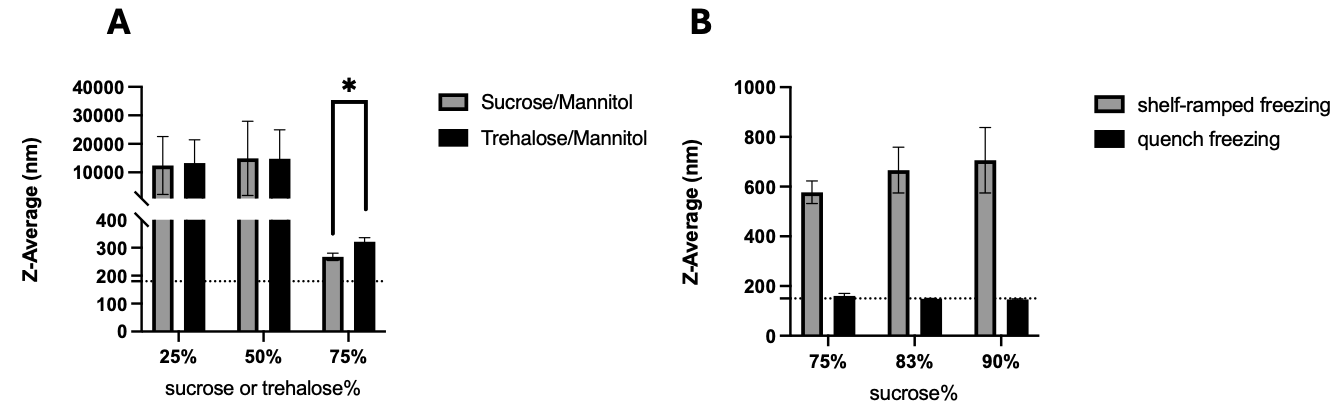 Figure 1. Preliminary Screening of Lyoprotectants and Freezing Conditions. (a) Screening of combinations of sucrose and mannitol (sucrose/mannitol) or trehalose and mannitol (trehalose/mannitol) for lyophilization of Nanosac. The combinations in varying ratios (sucrose or trehalose%) were used as a lyoprotectant, and their effects on the size of the reconstituted Nanosac were determined. The dashed line represents the Z-average of freshly prepared Nanosac (180 nm). All groups had a solid content of 1.5 % (w/v) and were quench frozen in liquid nitrogen and lyophilized with a Labconco freeze dryer. (b) Comparison of quench freezing in liquid nitrogen and shelf-ramped freezing at a rate of -1°C per minute. The dashed line represents the Z-average of freshly prepared Nanosac (183 nm). Sucrose/mannitol mixtures in indicated ratios were used as a lyoprotectant, with a solid content of 2.75 % (w/v).
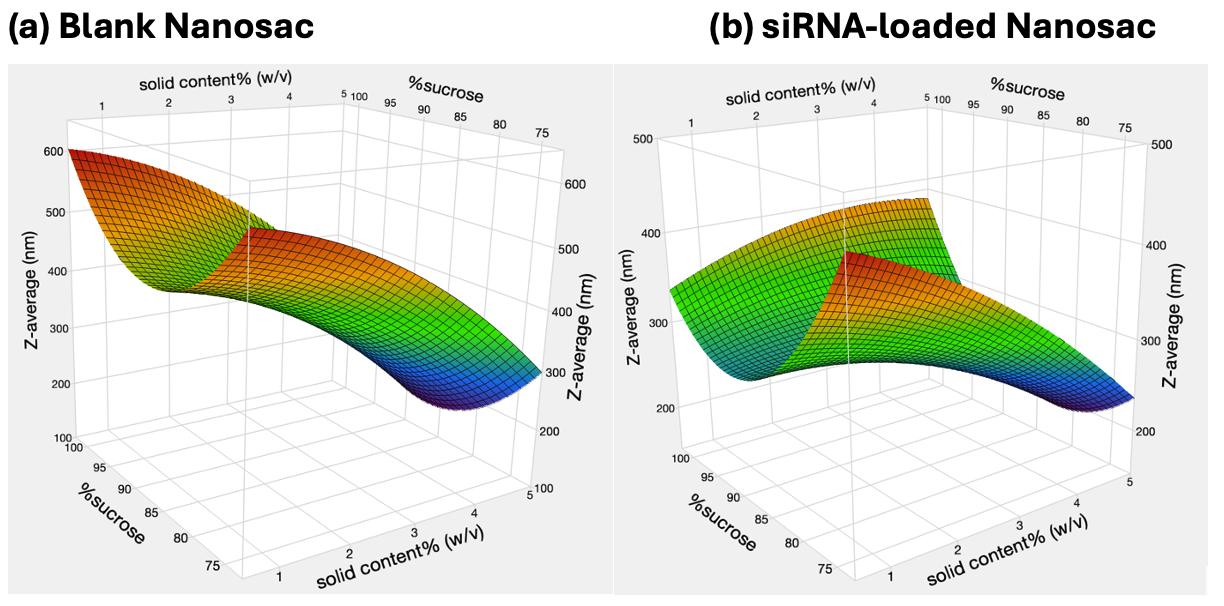 Figure 2. Response surface plots of the Z-averages for (a) blank Nanosac and (b) siRNA-loaded Nanosac, lyophilized with varying solid content% (w/v) and sucrose ratio (%) in the sucrose/mannitol combination.