
Formulation and Delivery - Chemical
Miguel O. Jara, Ph.D.
Research Fellow
University of Texas at Austin
Austin, Texas, United States
Miguel O. Jara, Ph.D.
Research Fellow
University of Texas at Austin
Austin, Texas, United States
Giselle Bedogni, n/a
Graduate student
Universidad Nacional de Rosario
Rosario, Santa Fe, Argentina
Lina Vargas Michelena, n/a
Graduate student
Universidad Nacional de Rosario
Rosario, Santa Fe, Argentina
Daniel Davis, Ph.D.
Principal Scientist
AustinPx
Georgetown, Texas, United States
Beatriz Behrend-Keim, n/a
Graduate Student
University of Texas at Austin
Austin, Texas, United States
Dave Miller, Ph.D.
Chief Scientific Officer
AustinPx
Georgetown, Texas, United States
Claudio Salomon, Ph.D.
Professor
Universidad Nacional de Rosario
Rosario, Santa Fe, Argentina

Robert O. Williams, III, PhD (he/him/his)
Professor
The University of Texas at Austin
Austin, Texas, United States
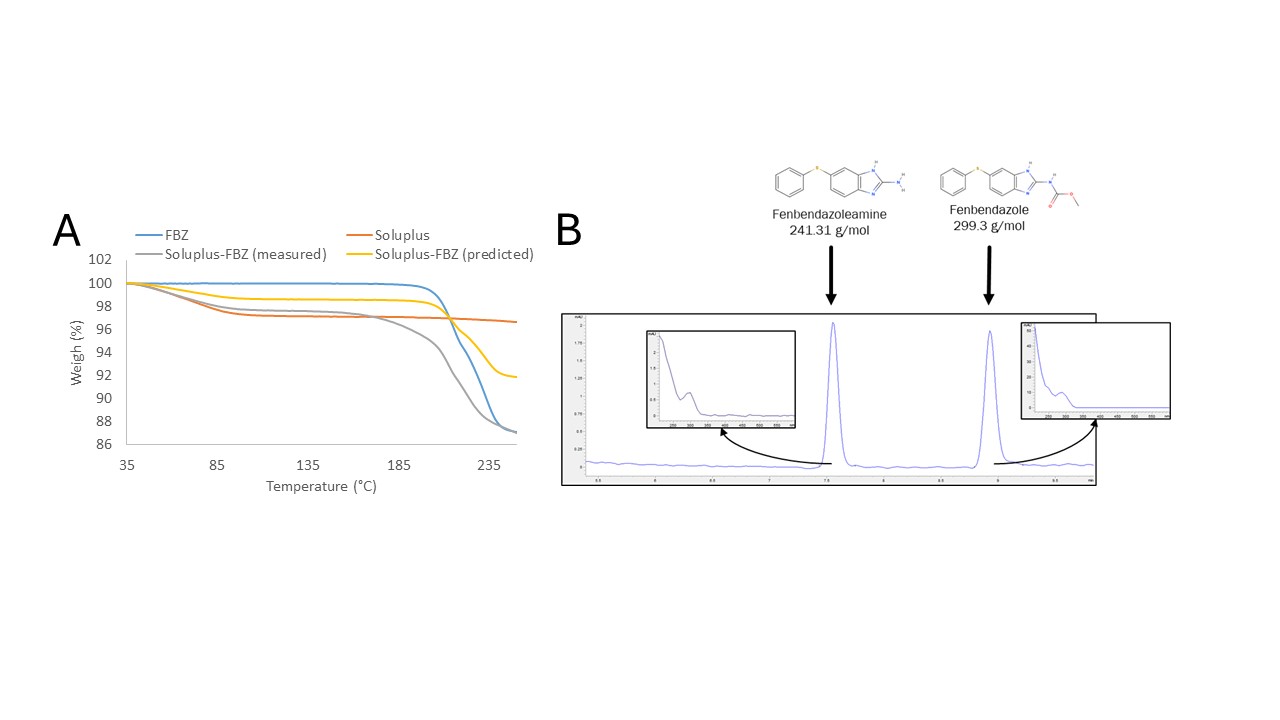 Figure 1. (A) TGA of FBZ, soluplus, and FBZ-soluplus physical mixture at 1:1 w/w ratio. (Additionally, the predicted weight loss of physical mixtures was added. It was considered the average of the FBZ and polymer curves). The samples were analyzed from 35°C to 250°C, using a heat rate of 10°C/min under Air 50 L/min. (B) Chromatogram of FBZ after undergoing thermal degradation
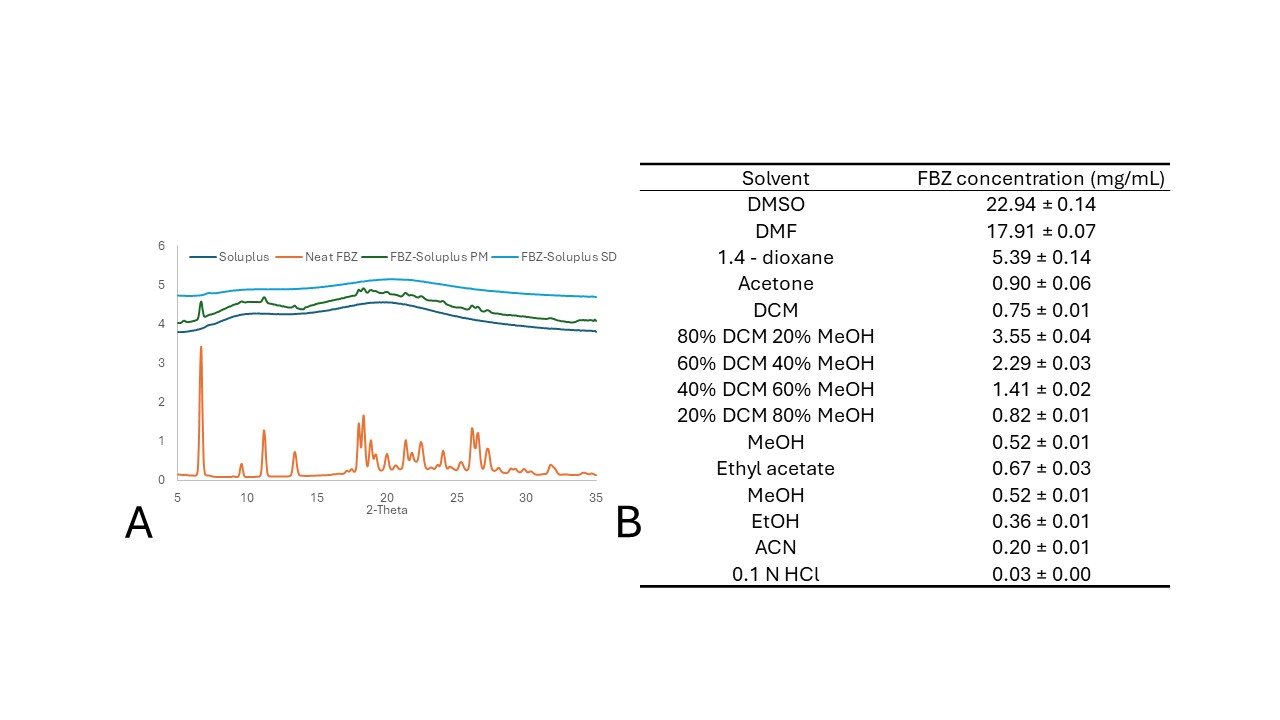 Figure 2. (A) Wide-angle X-ray diffractogram of crystalline FBZ, Soluplus, FBZ-Soluplus physical mixture, and FBZ-SD. (B) Solubility of FBZ in different solvent and cosolvent systems.
 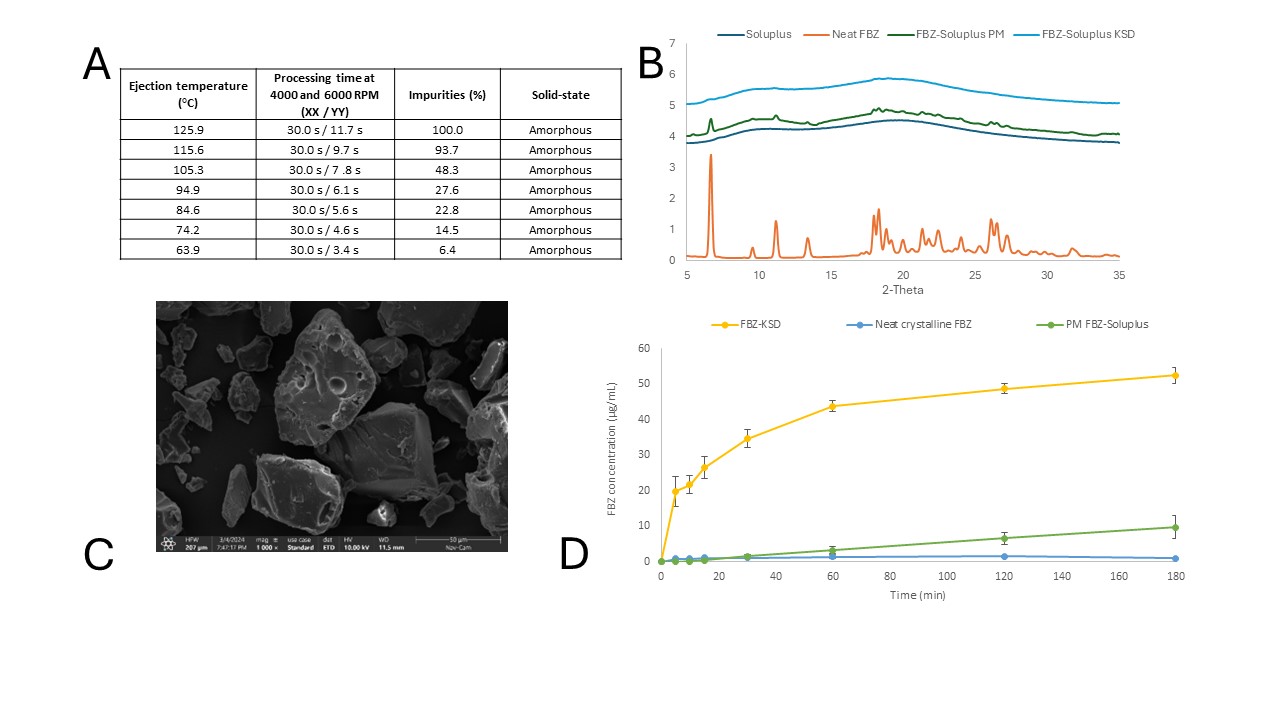 Figure 3. (A) FBZ potencies and solid-state after KinetiSol processing at different ejection temperatures. The samples were analyzed using LC-MS and WAXS. The sample with the lowest level of impurities was employed for further testing (FBZ-KSD). (B) Wide-angle X-ray diffractogram of crystalline FBZ, Soluplus, FBZ-Soluplus physical mixture, and FBZ-KSD. (C) SEM picture of FBZ-KSD . The bar shows a size of 50 µm. (D) Dissolution profile of neat crystalline FBZ, physical mixture of FBZ-Soluplus, and FBZ-KSD.