
Bioanalytics - Biomolecular
Chun-Wei Chi, Ph.D.
Research Scientist
University at Buffalo
Buffalo, New York, United States
Chun-Wei Chi, Ph.D.
Research Scientist
University at Buffalo
Buffalo, New York, United States
A.H. Rezwanuddin Ahmed, Ph.D.
Lecturer/Research Assistant
City College of New York
New York, New York, United States
Sihong Wang, Ph.D.
Associate Professor
City College of New York
NEW YORK, New York, United States
Yeh-Hsing Lao, Ph.D.
Assistant Professor
University at Buffalo
Buffalo, New York, United States
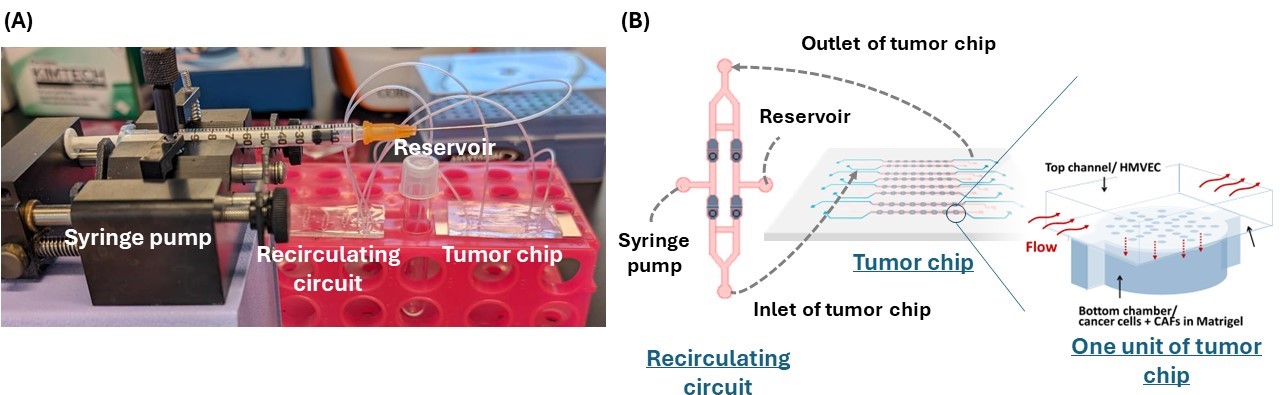 Figure 1. Design and configuration of our tumor chip and recirculating circuit. (A) A representative image showing the setup of this system. (B) Schematic illustration of connection between the recirculating circuit, reservoir, syringe pump and tumor chip (included an image showing one unit of tumor chip)
 Figure 2. CD8+ T cell infiltration and cancer cell’s apoptotic activity in different stromal and immunotherapeutic conditions. (A) A representative image of the tumor compartment with the microenvironment composed of cancer cell (MDA-MB-231), normal fibroblast, endothelial cell and CD8+ T cells, treated with anti-human PD-L1 antibody. MDA-MB-231 and T cell were labeled with GFP and DiI, respectively, and cancer cell’s apoptotic activity was monitored using NucView®405 Caspase-3 substrate (blue). (B) Quantitative analysis of the amount of DiI-stained T cell signals in the tumor compartment after 2-day recirculation. (C) Quantitative analysis of T cell-induced cancer cell apoptosis under different stromal conditions. Results are presented as average ± S.D. (n = 4). Significance was determined using one-way ANOVA with Tukey’s Multiple Comparison post-hoc test.