
Formulation and Delivery - Chemical
Mael Gallas, Pharm.D.
Manager Business Development North America and France, PhD Candidate
Rondol Industrie
Nancy, Lorraine, France
Shu Li, Ph.D.
Senior Lecturer
Queen's University Belfast
Belfast, Northern Ireland, United Kingdom

Victoire de Margerie, Ph.D.
Executive Chairman
Rondol Industrie
NANCY, Lorraine, France
Pascal Boulet, Ph.D.
Chief of Department CC X Gamma
Institut Jean Lamour
NANCY, Lorraine, France

Gavin P. Andrews, Ph.D. (he/him/his)
Chair of pharmaceutical engineering
Queen's University Belfast
Belfast, Northern Ireland, United Kingdom
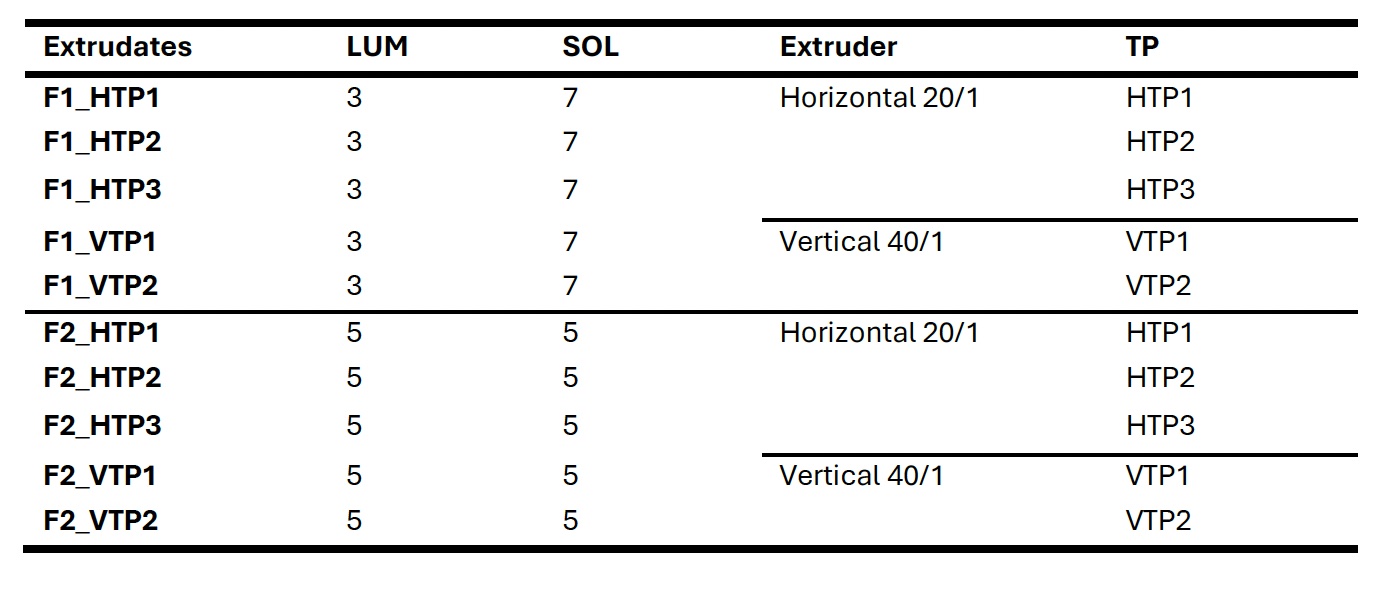 Table 1: Nomeclature of the formulations extruded in this study.
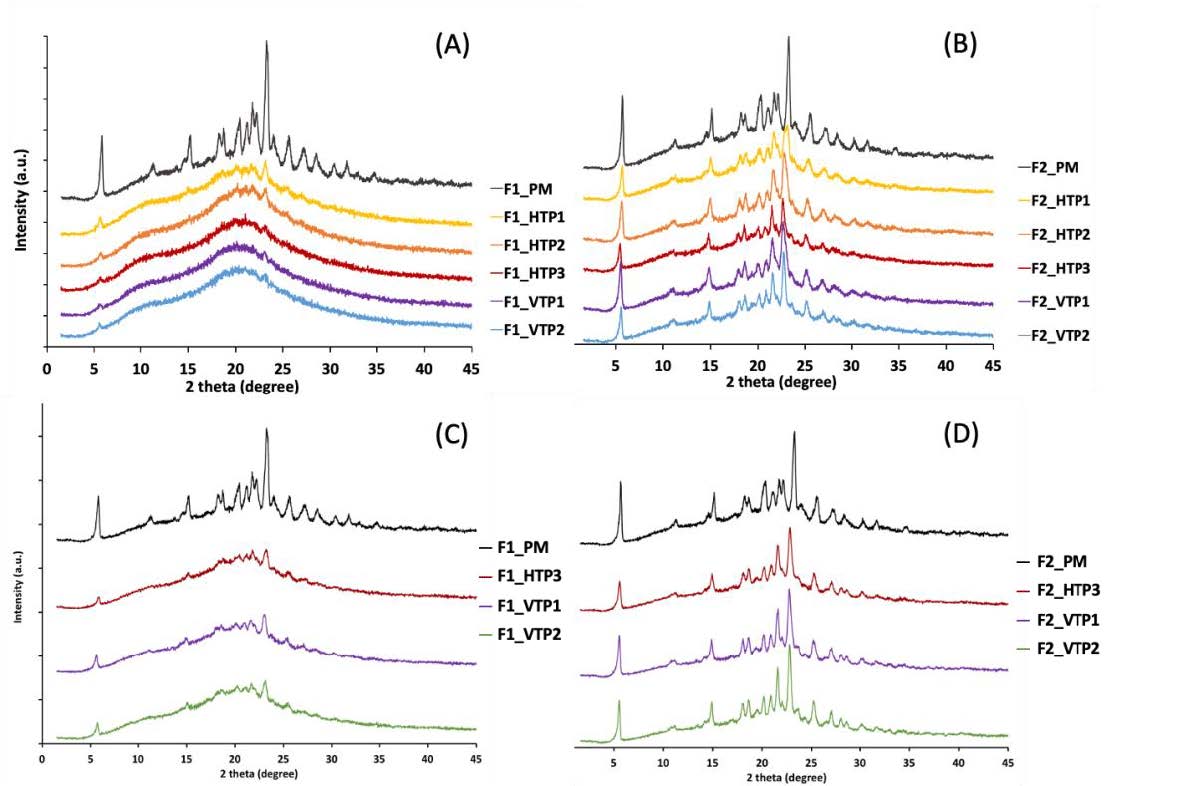 Figure 1. PXRD patterns of extruded formulations following storage under accelerated conditions (A) F1 extrudates over a 2-week period; (B) F2 extrudates over a 2-week period; (C) F1 extrudates over a 6-month period; and (D) F2 extrudates over a 6-month period. Note that the PXRD pattern of the physical mixture of each formulation is presented at the top of each diffractogram for comparison.
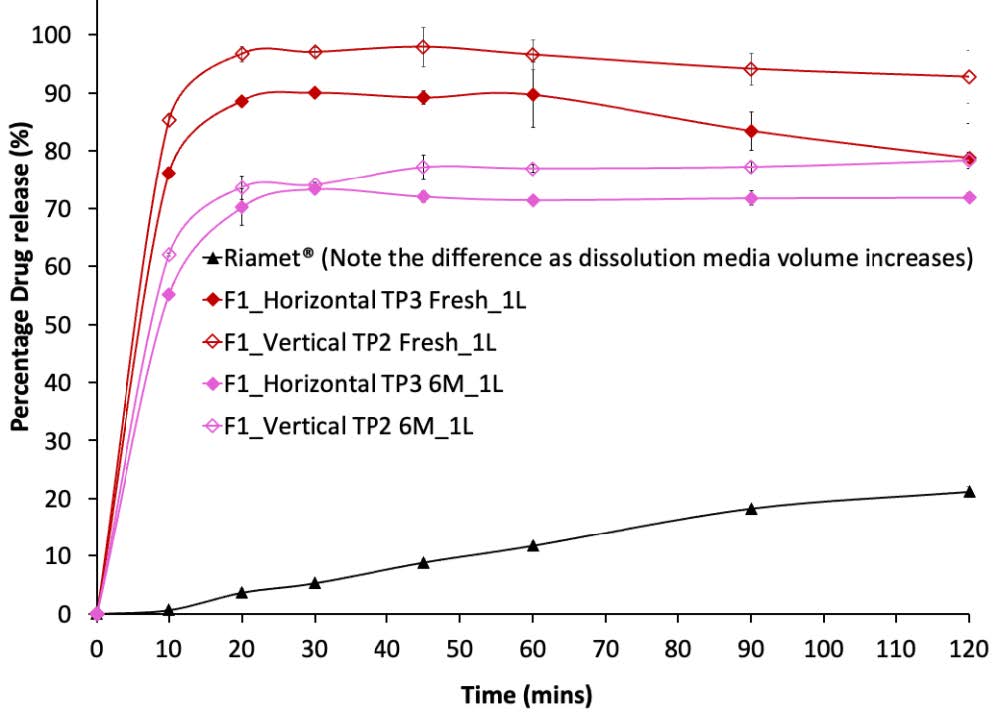 Figure 2. In-vitro drug dissolution profiles of the two most promising F1 formulations, F1_HTP3 and F1_VTP2, respectively, following storage under accelerated conditions for 6 months. Note that these dissolution tests were performed by putting formulations containing equivalent to 120 mg of LUM into 1 L of 0.1N HCl solution containing 1% (w/v) SLS. The dissolution profile of the commercial product (Riamet@), obtained using the same dissolution method, is plotted as comparison references. The dashed line represents the measured saturated solubility of crystalline LUM powders in the same medium.