
Formulation and Delivery - Chemical
Edmont Stoyanov, PhD (he/him/his)
Global Technical Director
Nisso Chemical Europe
Dusseldorf, Nordrhein-Westfalen, Germany
Andre Jaquier
PhD student
University of Applied Sciences and Arts Northwestern Switzerland
Basel, Basel-Stadt, Switzerland
Martin Kuentz, Ph.D.
Professor
University of Applied Sciences and Arts Northwestern Switzerland
Muttenz, Basel-Stadt, Switzerland
Andreas Niederquell, Pharm.D. (he/him/his)
Postdoc Student
University of Applied Sciences and Arts Northwestern Switzerland
Basel, Basel-Stadt, Switzerland
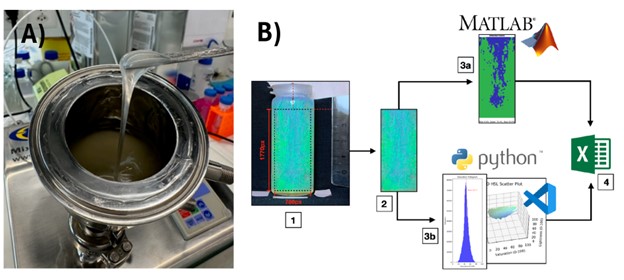 Figure 1 – A) The highly viscous HPC gels required manufacture using a micro-scale mixer that allowed processing under vacuum. B) Images of the samples were processed digitally to evaluate according to RGB or HSL, color analysis, respectively.
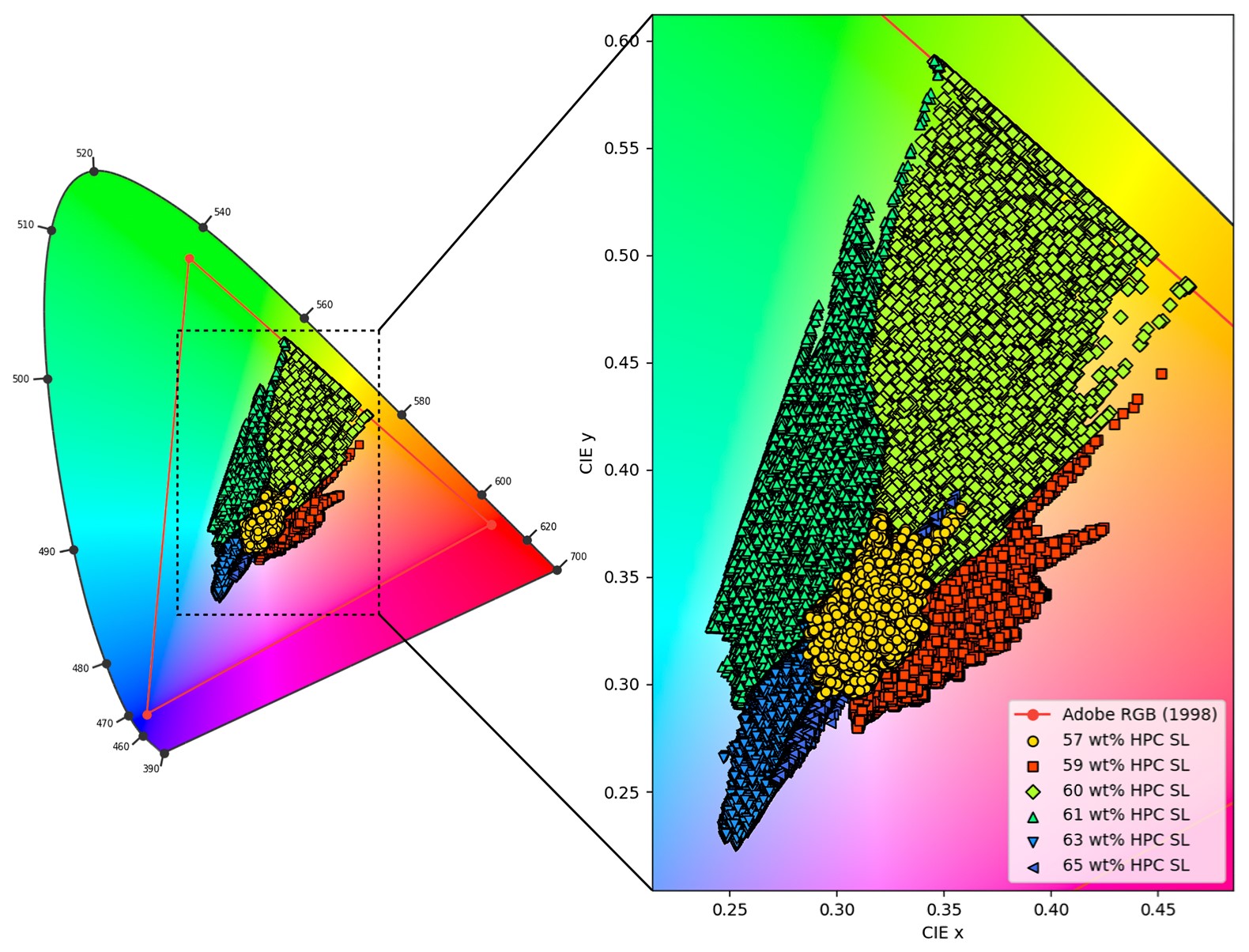 Figure 2 – Aqueous gels of HPC SL of initial trials as given in a CIE 1931 chromaticity diagram with all the plotted RGB values of the water-polymer gels with a HPC SL concentration of 57% w/w (yellow cir-cles), 59% w/w (red squares), 60% (light green diamonds), 61% w/w (upward-facing aqua green trian-gles), 63% w/w (downward-facing light blue triangles) and finally, 65% w/w (dark blue left-facing trian-gles). The triangle with red lines represents the boundary of colorations within the Adobe RGB 1998 standard gamut, which was defined during the conversion of images from DNG to TIFF format.
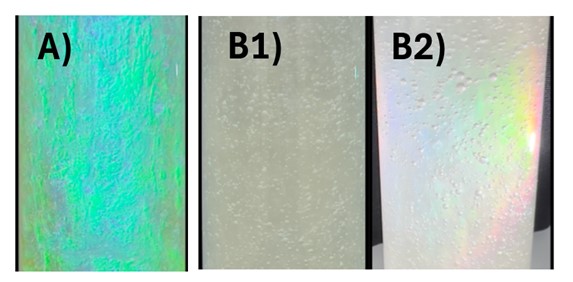 Figure 3 – A) 60% w/w HPC SL gel in 35% w/w water with 5% w/w glycerin and B1) as well as B2) are co-solvent systems with 60% w/w HPC SL, 10% w/w water and 30% diethylene glycol monoethyl ether. B2) shows the situation of a locally incoming light from the right side, which reveals a clear iridescence that is otherwise not well detected at ambient light conditions.