
Formulation and Delivery - Chemical
Daniel Francisco Moraga-Espinoza, Ph.D. (he/him/his)
Assistant Professor
Universidad de Valparaiso
Valparaiso, Valparaiso, Chile
Sofia Rojas, n/a
undergraduate
Universidad de Valparaiso
valparaiso, Valparaiso, Chile
Sofia Rojas, n/a
undergraduate
Universidad de Valparaiso
valparaiso, Valparaiso, Chile
Camila Galdavini, n/a
Undergraduate
Universidad de Valparaiso
valparaiso, Valparaiso, Chile
Luis Monrreal, MSc
Postgraduate
Universidad de Valparaiso
Valparaíso, Valparaiso, Chile
Tania Francisca Bahamondez, n/a (she/her/hers)
Professor
Universidad de Valparaiso
valparaíso, Valparaiso, Chile
Claudia Soza, n/a
Undergraduate
Universidad de Valparaiso
valparaíso, Valparaiso, Chile
Javier O. Morales, Ph.D.
Pharmaceutical Sciences PhD
Universidad de Chile
Santiago, Region Metropolitana, Chile
Pedro Torres, n/a
Postdoc
Universidad de Chile
Valparaíso, Valparaiso, Chile
.jpg) Figure 1: Franz cell dissolution test to evaluate the dissolution profile of the amorphous solid dispersion formulations. Dissolution profiles of A) DOX-HPMC and B) DOX-GA GA microspheres. Percentages in the nomenclature represents the fraction of DOX in the formulation.
Figure 1: Franz cell dissolution test to evaluate the dissolution profile of the amorphous solid dispersion formulations. Dissolution profiles of A) DOX-HPMC and B) DOX-GA GA microspheres. Percentages in the nomenclature represents the fraction of DOX in the formulation. 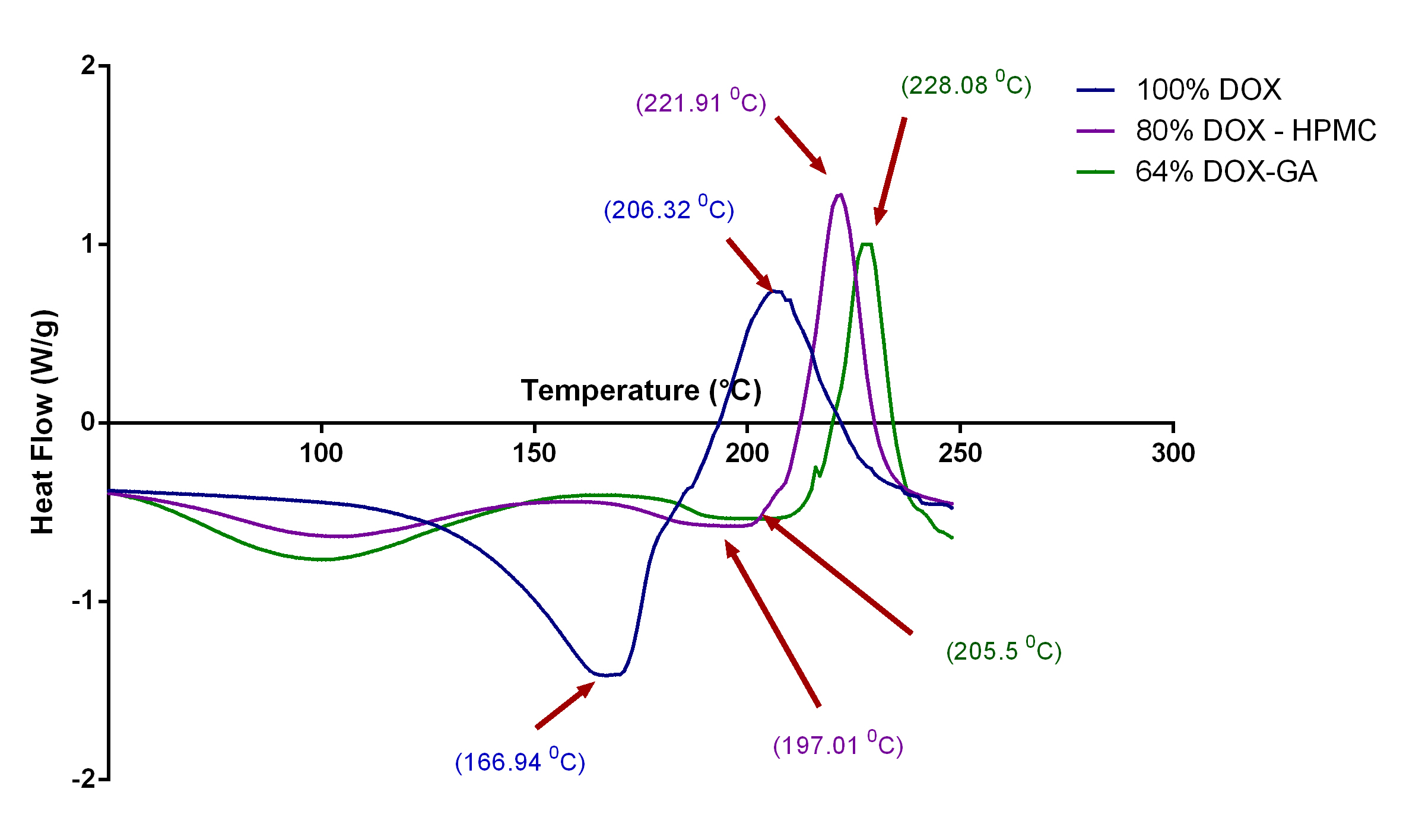 Figure 2: Dynamic scanning calorimetry profiles of the Doxycycline (blue) , and its combinations with hydroxypropyl methylcellulose (HPMC) (magenta) and Gelatin (green). The endothermic peaks represent the melting point of DOX and the exothermic peaks its degradation signal. The displacement to the higher temperatures are the proof of partial amorphization.
 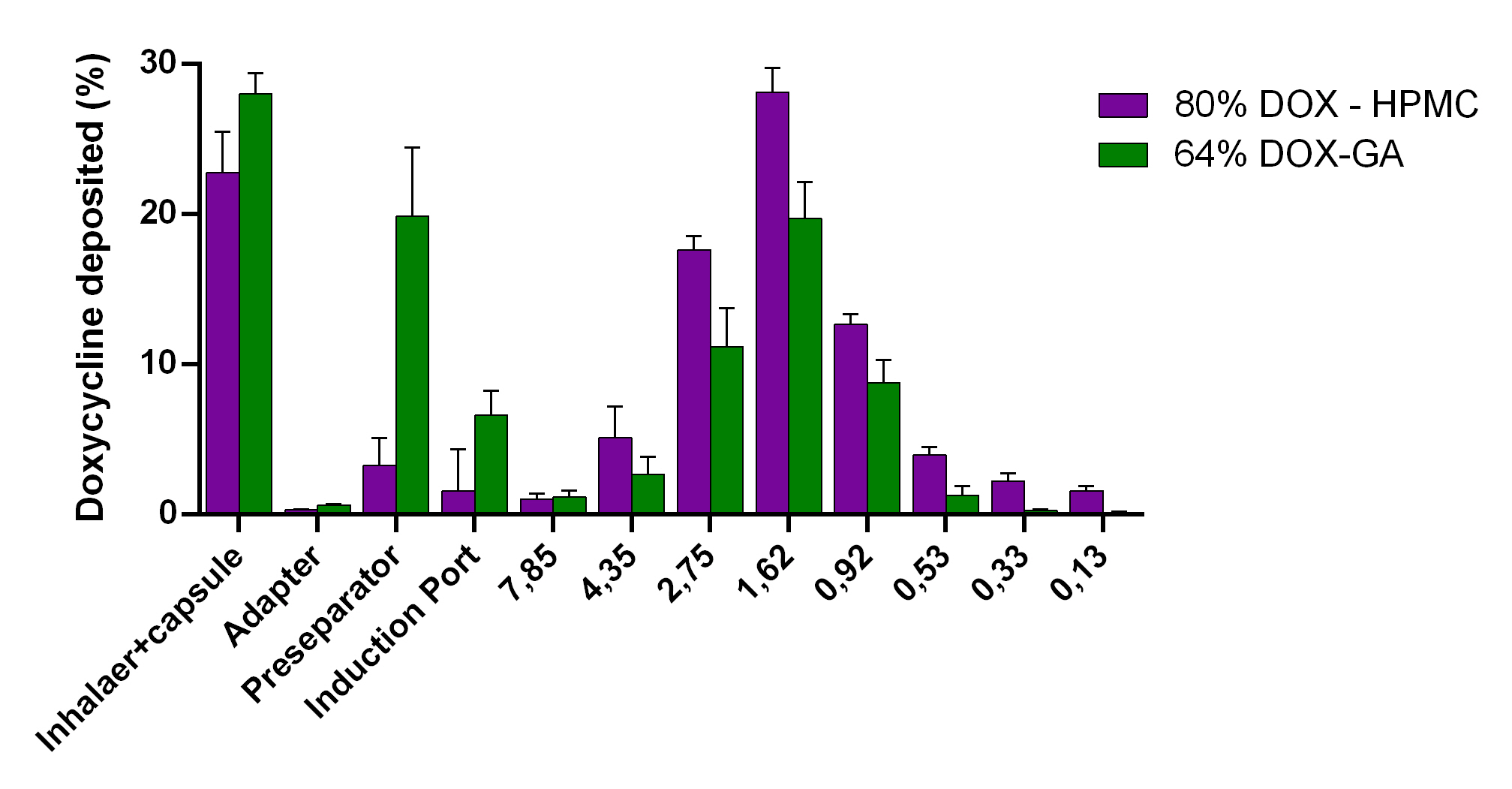 Figure 3: Aerodynamic particle size distribution of the formulations of the dry powder formulation with the highest dissolution rates.