
Formulation and Delivery - Biomolecular
Snehal S. Daware, M.Tech (she/her/hers)
Graduate Student
St. John's University
New york, New York, United States
Snehal S. Daware, M.Tech (she/her/hers)
Graduate Student
St. John's University
New york, New York, United States
Vishvesh Raje, MS (he/him/his)
Doctoral Student
St. John's University
New York, New York, United States
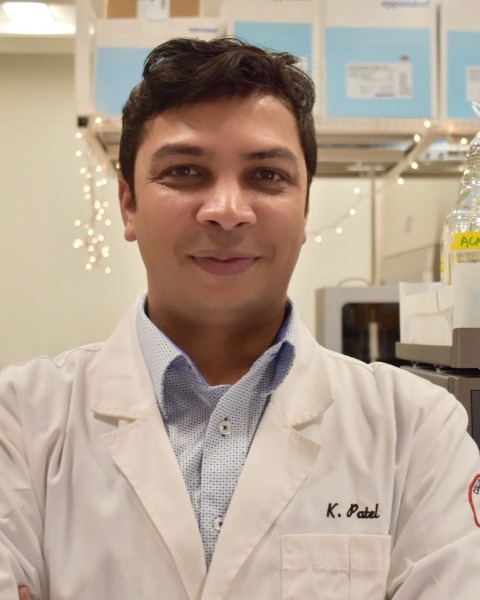
Ketan D. Patel, Ph.D. (he/him/his)
Associate Professor
St. John's University
Queens, New York, United States
 Figure 1(A) 2D contour interaction plots between factors A. Thickness and B. Microneedle height at lower concentration of agarose (2%), understanding the effect of trends on % drug release at three response variables (1, 3 and 6h) illustrating increasing the MNs height has significant increase in % drug release at 3 and 6h. (B) 3D interaction plots at lower concentration agarose showing increase in microneedle height increases the %drug release
 Figure 2 (A, B) 2D and 3D interaction plots for Thickness and MN height at higher concentration of agarose on % drug release indicating lower microneedle height has substantial effect on drug release at lower concentration compared to higher MNs height and higher concentration the effect is less pronounced.
  Figure 3 (A) Fluorescence images of FITC-dextran loaded 1000µm microneedles captured using a confocal microscope(B) Graphical representation of in vitro dissolution setup using 3D Printed Imprint (C) In vitro dissolution release patterns of the different MN batches generated from full factorial design via DOE