
Formulation and Delivery - Chemical
Overcoming Incompatibility between Moxifloxacin and Carbopol<sup>®</sup>934 Polymers in Ophthalmic Drug Delivery Systems

Mona M. Geweda, BS
Doctoral Candidate
University of Mississippi
oxford, Mississippi, United States
Mona M. Geweda, BS
Doctoral Candidate
University of Mississippi
oxford, Mississippi, United States
Corinne Varner, Ph.D.
Visiting Instructional Assistant Professor of Pharmaceutics and Drug Delivery
University of Mississippi
University, Mississippi, United States
Ahmed Youssef, Ph.D.
Doctoral Candidate
University of Mississippi
University, Mississippi, United States

Soumyajit Majumdar, Ph.D.
Associate Dean for Research and Graduate Programs, Professor of Pharmaceutics and Drug Delivery
University of Mississippi
University, Mississippi, United States
.jpg) Figure 1. In vitro release-diffusion profile of Moxifloxacin (MOX) from control solution (0.5%) and MOX-Carbopol® 934 complex mixtures. The release-diffusion studies were carried out using a Thermo Scientific Slide-A-Lyzer™ MINI dialysis device (10 K MWCO). Data represents mean ± SD (n = 3).
Figure 1. In vitro release-diffusion profile of Moxifloxacin (MOX) from control solution (0.5%) and MOX-Carbopol® 934 complex mixtures. The release-diffusion studies were carried out using a Thermo Scientific Slide-A-Lyzer™ MINI dialysis device (10 K MWCO). Data represents mean ± SD (n = 3). 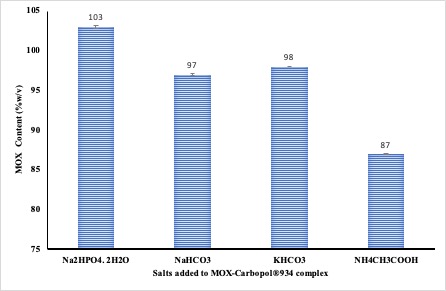 Figure 2. The Moxifloxacin (MOX) content in solution following the addition of 2 mL of 1M of different salts solutions (Na2HPO4.2H2O, NaHCO3, KHCO3, and NH4CH3COOH) to 2 mL of MOX-Carbopol®934 (1:1) reaction mixture. Data represents mean ± SD (n = 3).
 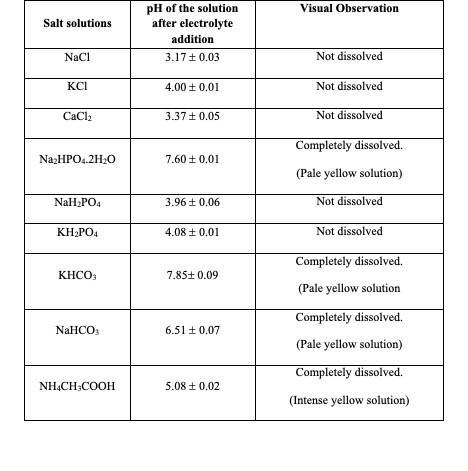 Table 1. pH and visual observations following the addition of 2 mL of nine salt solutions (1M) to MOX-Carbopol®934 (1:1) reaction mixtures.